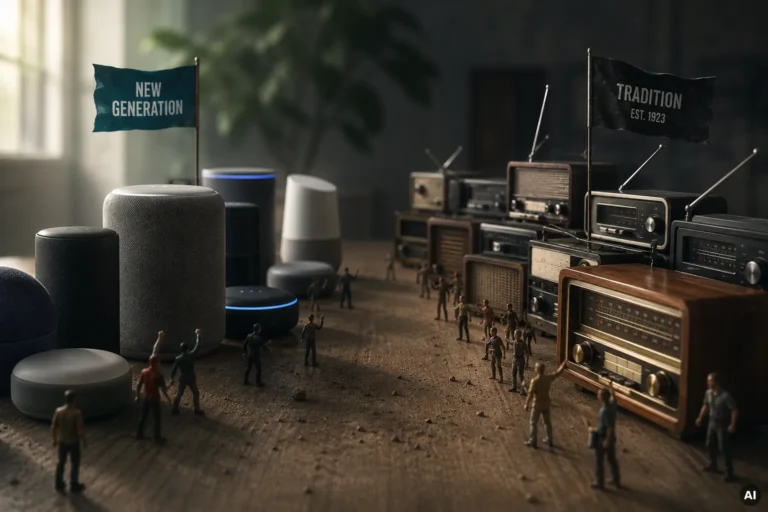
In marketing, we often talk about the brand core, the foundation of a brand, which defines its fundamental values, goals, and vision. Other marketing managers talk about the USP, the incentive to buy that sets you apart from the competition. All clear and logical, if it weren't for one question. The question that concerns me regarding radio. What actually is my product? What actually is radio? Where does it start, where does it end? And what's in between?
It should be briefly mentioned that I am no stranger to the field of „audio content“ marketing. I am quite knowledgeable, but I am increasingly struggling to define the product that is radio. For example, if I look at the Media Analyse (Media Analysis), there is audio, radio, online audio, DAB+, simulcast, user-generated radio, web-only stations, music streaming, etc. In the study Massenkommunikation Trends (Mass Communication Trends), under the heading Audio, podcasts and music on YouTube also appear, and in the Online Audio Monitor, „offshoots“ of classic radio stations are also spoken of in the context of online audio.
From my perspective, „audio“ encompasses a confusing mix of transmission channels, advertising offers, platforms, and programmes, a subset of which is referred to as “radio“ depending on how you interpret it. And when I then say to my friendly companion Alexa, "Play Hard Rock," and she cheerfully replies, "Now playing Hard Rock from Amazon Music," then I'm truly lost. A radio station from Amazon called Hard Rock? Seriously?
Let's get back to the core question: What actually is radio, and what is the core brand of radio? What is the USP of radio that contributes to 53 million people listening to this medium for over 4 hours daily?
Not at all easy to define universally. And to avoid a storm of criticism with lots of definitions, sources, and study results, I'll dispense with a generally valid definition and just define my “radio formula“ for myself. The two really big factors that, for me, make something that's heard into radio are the curation of content and the presentation with information and entertainment.
So that means:
- I am choosing a product that provides me with auditory content corresponding to my specifications (musical preferences, region, etc.), which I don't have to put together myself, but which I also cannot significantly alter in terms of time and content.
- Within this product, I am accompanied by moderation. Whether they just briefly tell me the name of a song, what time it is, or tell me editorial contributions about world events for hours.
While writing this “radio formula,“ the thought is constantly rattling around in my head whether I'm doing justice to all the exceptions, eventualities, and innovations. I'd much rather work with a thousand footnotes. For example, does this definition do justice to the new „skipping“ on the radio? Or the possibility of influencing the programme so that I never have to listen to Peter Maffay again? Or is the sparse moderation of my favourite web radio really enough for this formula? And what about artificial voices? Is Radio Helgoland, which is completely created by AI, with artificial voices and programmed music selection, really radio?
For me, radio is about accompanying me through the day and being authentic. That someone selects the music and information for me, someone who is good at it, and that I can concentrate on what I need to do while listening. Someone who surprises me, entertains me, makes me laugh, and warns me. And that live. Or at least in a way that makes me feel like it's live. Whether it's with an artificial voice or an automatically generated playlist. But there's someone on the radio who is speaking to me.
And incidentally, I think it's absolutely wonderful when I don't have to make any decisions while listening. Whatever comes, comes. I don't have to press “next“ for so long until I finally get the song I supposedly want to hear. I wait until the news comes on. And I listen to it, regardless of whether I would have spontaneously decided to get informed or not. I listen to the new song by a musician I actually find terrible, only to discover that I actually like it a little. I simply don't want to think, decide or act. Of course, there are limits. For me, the limit is called Peter Maffay. Then all I can do is curse, switch channels or skip.
To me, all of that is the core of radio, whether it's listened to via DAB+, FM, web, or Alexa. It doesn't matter if the radio station is called FFH, Radio Bollerwagen, or NDR 2. However, a “playlist radio“ from Amazon or similar with hard rock, or a web radio completely without moderation, or a suggested playlist from Spotify cannot achieve this. And in my personal “radio formula,“ that's simply not radio.
Too simplistic a view? Perhaps. But it's important to me to understand how radio works and what defines it. And that online audio, which sounds considerably more modern, is a transmission channel with specific possibilities for advertising placement and additional features. But it says nothing about a product or a brand. That playlists and user-generated content are a great thing, but have little to do with radio. I listen to my music then, whether it's via vinyl, CD, or playlist.
To conclude with Faust and the heart of the matter: radio has changed. It comes via many different routes and in many forms, accompanying us even into our studies. But it will not turn into Mephistopheles. It remains true to its core brand identity as radio. Regardless of whether it's called audio, online audio, or simulcast. In the end, it accompanies us, some on a walk, others through life.
Yours Juliane Henze
These posts might interest you