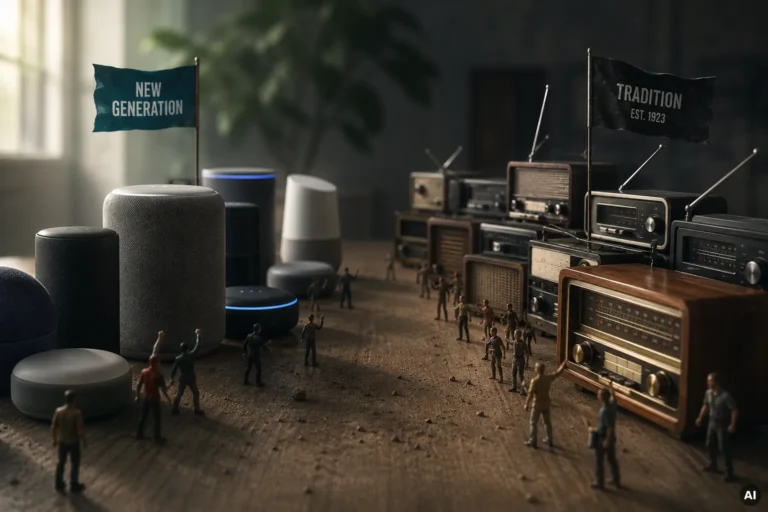
For decades, I've been intensely involved in securing the future of the radio business, specifically the advertising business of private radio publishers. It's a difficult task, as we know. The media landscape is changing as rapidly as predictions about business development and the future of traditional radio. One moment, it's online audio that is supposedly set to replace and inherit radio. The next, media convergence is hyped, or AI is presented as a game-changer. The analyses, forecasts, and recommendations shift and often contradict each other. Nevertheless, „experts“ usually sell their concept as the only correct one.
Currently, online booking and programmatic are being touted in the industry as the sole and revolutionary saviours of the radio business. Everything is supposed to be turned upside down, current systems replaced or abolished, and the entire advertising business relocated to a single online platform. Not a stone is to be left unturned. All of this supposedly works „very simply“ and is cheaper to boot, as certain platform operators claim. Such bold and unsubstantiated promises understandably breed suspicion.
So what now? Which path should be taken? Which business model should be adopted?
After 30 years in business and consulting, I can humbly claim to know the radio and audio industry inside out. As co-founder and managing director of „amily“, the leading advertising management system in the DACH region, and one of the first digital trading platforms for linear radio advertising, „amy“, I venture to state that there are simply no „one-size-fits-all solutions and magic bullets“. The market participants, their interests and business models – from mini local stations to global media corporations – are far too heterogeneous for that.
The reality of the radio advertising business consists of many models with many nuances. Together, these have secured advertising revenue and thus thousands of jobs for years. Experience teaches us not to completely discard these models in favour of a supposedly current trend. The same applies to IT programmes and systems that radio stations and marketers may have been using for decades.
Therefore, in my firm conviction, there is no high-risk „either/or,“ but rather a sustainable, solid „both/and.“ The classic radio advertising business remains the strong revenue stream that must by no means be endangered. This is shown, among other things, by the advertising revenues from Online Audio, which increased far less strongly than its protagonists predicted.
Instead, I recommend every publisher undertake a continuous, sustainable, and low-risk change and modernisation process that takes the teams along, optimises proven processes and systems, and harmoniously integrates new approaches, technologies, and models.
Integration and Evolution
I am convinced that further developing a functioning business can best be driven forward through an integrative, evolutionary approach. Integrative means that existing and new business models can coexist harmoniously. The existing continues to produce, the new is integrated and from that, something new emerges.
This is not „revolutionary,“ but evolutionary, risk-minimised, and therefore realistic. This is how change is achievable and sustainably successful for every company at its own pace.
Convergence
Let's not kid ourselves: after 15 years of online audio marketing, this monetisation source has, at best, become a good supplementary income. Imagine if, as a radio publisher, you'd thrown over the classic radio business (IO) to bet everything on this. That would likely have been your financial ruin. Because, as mentioned above, classic radio still secures the main business.
My recipe is therefore: Expand and Integrate. Tap into new sources without neglecting radio as a central revenue stream. Pursue new marketing channels without discarding proven ones.
Networking
Every company is a complex structure in which many actors and systems fulfil their functions and are interconnected. Through clever networking and seamless communication, different strategies and the respective best solutions for specific tasks and functions can be combined. This is the foundation for everything else and guarantees greater flexibility and independence than relying on a single solution path.
Automation
Automation isn't everything. But everything is nothing without automation.
It's certainly not that dramatic, but those who want to survive in a fast-paced competitive environment cannot do without highly efficient, automated processes and functions. This applies to all areas of business operations: from lead generation to billing.
Programmatic
The automation of sales and booking processes plays a central role. The programmatic trading of linear advertising inventory on online platforms is certainly not the „only true future“ of the radio business, as some claim, in my opinion. However, it is an additional revenue stream for the radio business that every radio publisher should tap into if possible. A third, largely automated channel alongside established local and national marketing, which many advertisers and agencies already prefer for their campaigns today.
The easiest approach for publishers will be to offer „real“ radio inventory directly and automatically from their existing ad management system, and for electronically confirmed bookings to be fed back directly into campaign management. And of course, it must be ensured that sellers or publishers retain control over the use of their inventory. Only they should decide which part of their inventory is made available for electronic trading, when and under what conditions. And which customers can advertise on their programmes, or not.
Any automation approach would be incomplete if it did not map the entire process. This means that the advantage of automated or programmatic inventory marketing is only truly realised if the advertising sold in this way is also automatically transmitted, broadcast, and billed to the broadcasting systems.
So the circle is closed: „Programmatic“ for radio is, in my firm belief, a seductive but risky hype if publishers abandon their business model overnight and radically align their marketing to it. Programmatic, on the other hand, is a huge opportunity to reduce the gap with digital competitors (keyword GAFA) and win new customers. Provided that the technology is integrated and further developed evolutionarily within the existing business model.
Stay tuned for the future.
You are Nico Aprile
These posts might interest you.