Smart speakers are long since more than just an additional distribution channel for radio. Power in the audio market is increasingly shifting towards the platforms, because Amazon, Google and Apple control the value chain from the hardware to the AI routing.

For radio stations, this creates a central problem: they supply content, but have only limited influence on discoverability, data access and monetisation. In May 2026, Goldmedia GmbH produced the study „Importance of smart speakers for German radio: Perspectives - Opportunities - Risks“ on behalf of the directors' conference of the media authorities (DLM). It sheds light on the structural imbalance between radio stations and the dominant smart speaker platforms.

platform power

Platforms: In the smart speaker market, Amazon, Google and Apple control the value chain from hardware to AI routing.

Radio station Commercial radio broadcasters are becoming content suppliers without decisive influence on discoverability, data access, or monetisation.

The structural asymmetry in the smart speaker market

The study describes an asymmetric market structure in which platforms hold the decisive levers and radio broadcasters are structurally weaker positioned in the smart speaker environment.

Particularly relevant is the data gap: without sufficient access to data, targeted marketing is made more difficult, while platforms can use the same data to build their own audio offerings.

According to the study, the value-exchange model also shows that the equivalent value for radio falls well short of the value that platforms derive from its use. In a best-case scenario, existing findability regulations, fair data access and greater routing transparency could contribute to a more balanced distribution of value.

Otherwise, without appropriate measures, the radio sector could lose a cumulative total of 265 million euros in gross margin and 65 million euros in net value added between 2026 and 2030.

data gap

Missing data: Radio stations receive barely any context data, routing information, or sociodemographic profiles for addressable advertising.

Platform Black Box: Following a voice command, the voice assistant automatically decides which content or service to play. This makes it difficult to measure reach and advertising impact accurately.

Economic impact: Whilst platforms can use the data for their own audio services, radio stations’ marketing opportunities remain limited and the CPM is stagnating.

The changing market

The market has grown significantly in recent years. In 2025, around 50 million devices were being used for smart speaker services in Germany. Around 12 million households owned such devices.

At the same time, the study shows that a large proportion of smart speaker usage does not generate any real additional reach, but rather shifts existing radio listening to a different listening context.

Smart speakers therefore create new usage scenarios, but do not automatically result in financial gains for radio stations.
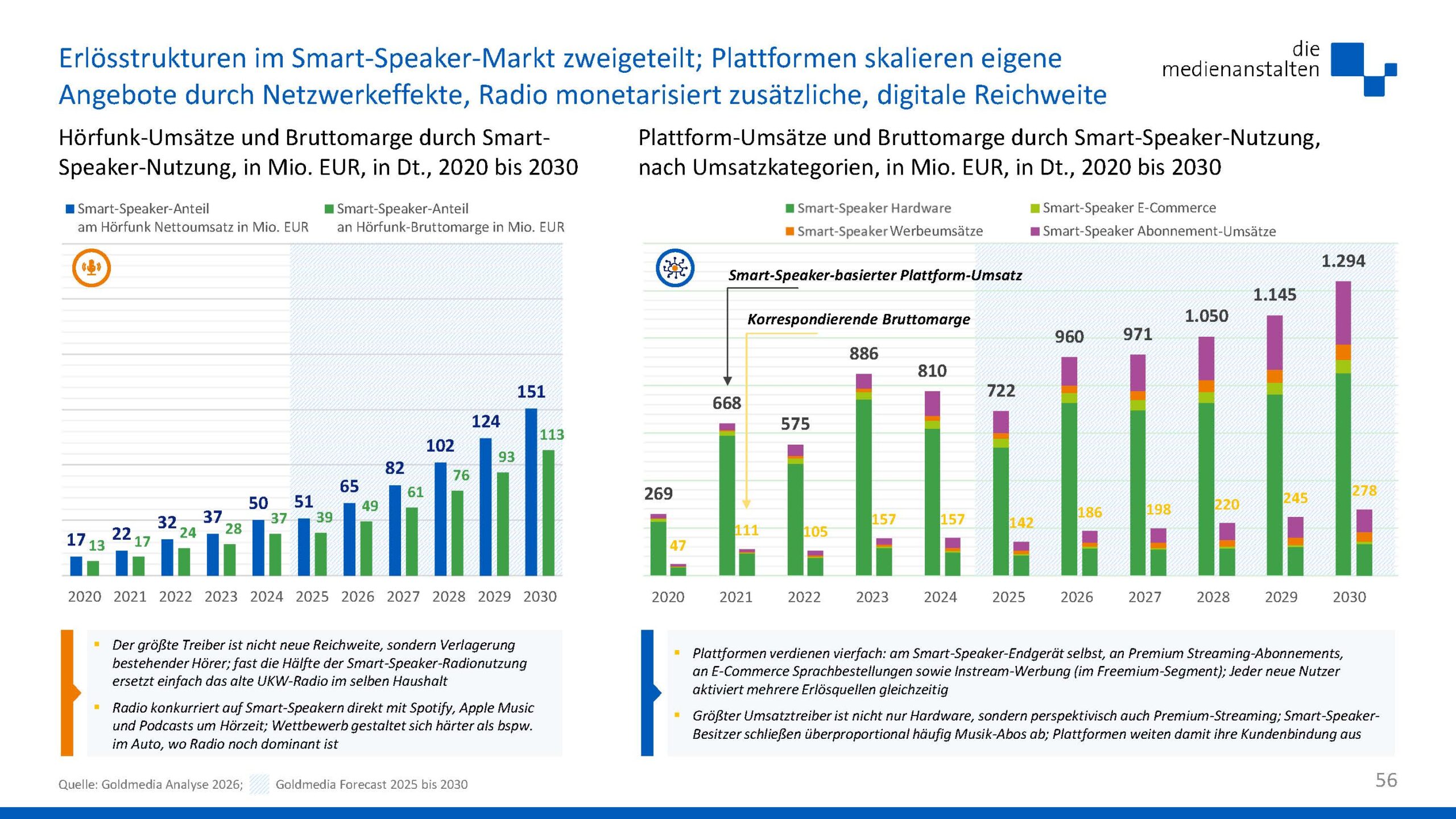
Erlösentwicklung von Radiosendern und Plattformen durch Smart Speaker in Deutschland von 2020 bis 2030
Revenue streams in the smart speaker market are unevenly distributed: whilst radio stations generate only limited additional revenue, platform providers benefit significantly more from hardware, subscriptions, advertising and e-commerce. Source: Goldmedia study commissioned by the media authorities, 2026.

Goldmedia Study, May 2026

Smart speakers are long since more than just an additional distribution channel for radio. Power in the audio market is increasingly shifting towards the platforms, because Amazon, Google and Apple control the value chain from the hardware to the AI routing.

For radio stations, this creates a central problem: they supply content, but have only limited influence on discoverability, data access and monetisation. In May 2026, Goldmedia GmbH produced the study „Importance of smart speakers for German radio: Perspectives - Opportunities - Risks“ on behalf of the directors' conference of the media authorities (DLM). It sheds light on the structural imbalance between radio stations and the dominant smart speaker platforms.

platform power

Platforms: In the smart speaker market, Amazon, Google and Apple control the value chain from hardware to AI routing.

Radio station Commercial radio broadcasters are becoming content suppliers without decisive influence on discoverability, data access, or monetisation.

The structural asymmetry in the smart speaker market

The study describes an asymmetric market structure in which platforms hold the decisive levers and radio broadcasters are structurally weaker positioned in the smart speaker environment.

Particularly relevant is the data gap: without sufficient access to data, targeted marketing is made more difficult, while platforms can use the same data to build their own audio offerings.

According to the study, the value-exchange model also shows that the equivalent value for radio falls well short of the value that platforms derive from its use. In a best-case scenario, existing findability regulations, fair data access and greater routing transparency could contribute to a more balanced distribution of value.

Otherwise, without appropriate measures, the radio sector could lose a cumulative total of 265 million euros in gross margin and 65 million euros in net value added between 2026 and 2030.

data gap

Missing data: Radio stations receive barely any context data, routing information, or sociodemographic profiles for addressable advertising.

Platform Black Box: Following a voice command, the voice assistant automatically decides which content or service to play. This makes it difficult to measure reach and advertising impact accurately.

Economic impact: Whilst platforms can use the data for their own audio services, radio stations’ marketing opportunities remain limited and the CPM is stagnating.

The changing market

The market has grown significantly in recent years. In 2025, around 50 million devices were being used for smart speaker services in Germany. Around 12 million households owned such devices.

At the same time, the study shows that a large proportion of smart speaker usage does not generate any real additional reach, but rather shifts existing radio listening to a different listening context.

Smart speakers therefore create new usage scenarios, but do not automatically result in financial gains for radio stations.
Goldmedia study, May 2026

Infobox – The development of voice assistants

Daily range: The number of people using smart speakers on a daily basis rose from around 0.7 million in 2019 to around 4.9 million in 2025.

Audio usage: During the same period, the number of people using audio content via smart speakers rose from 5.8 million to 16.2 million.

Why platforms are becoming a risk

The real challenge lies not just in the technology, but in the platform logic. Access via voice often means access via aggregators, pre-set services and routing mechanisms that lie outside the broadcasters' control.

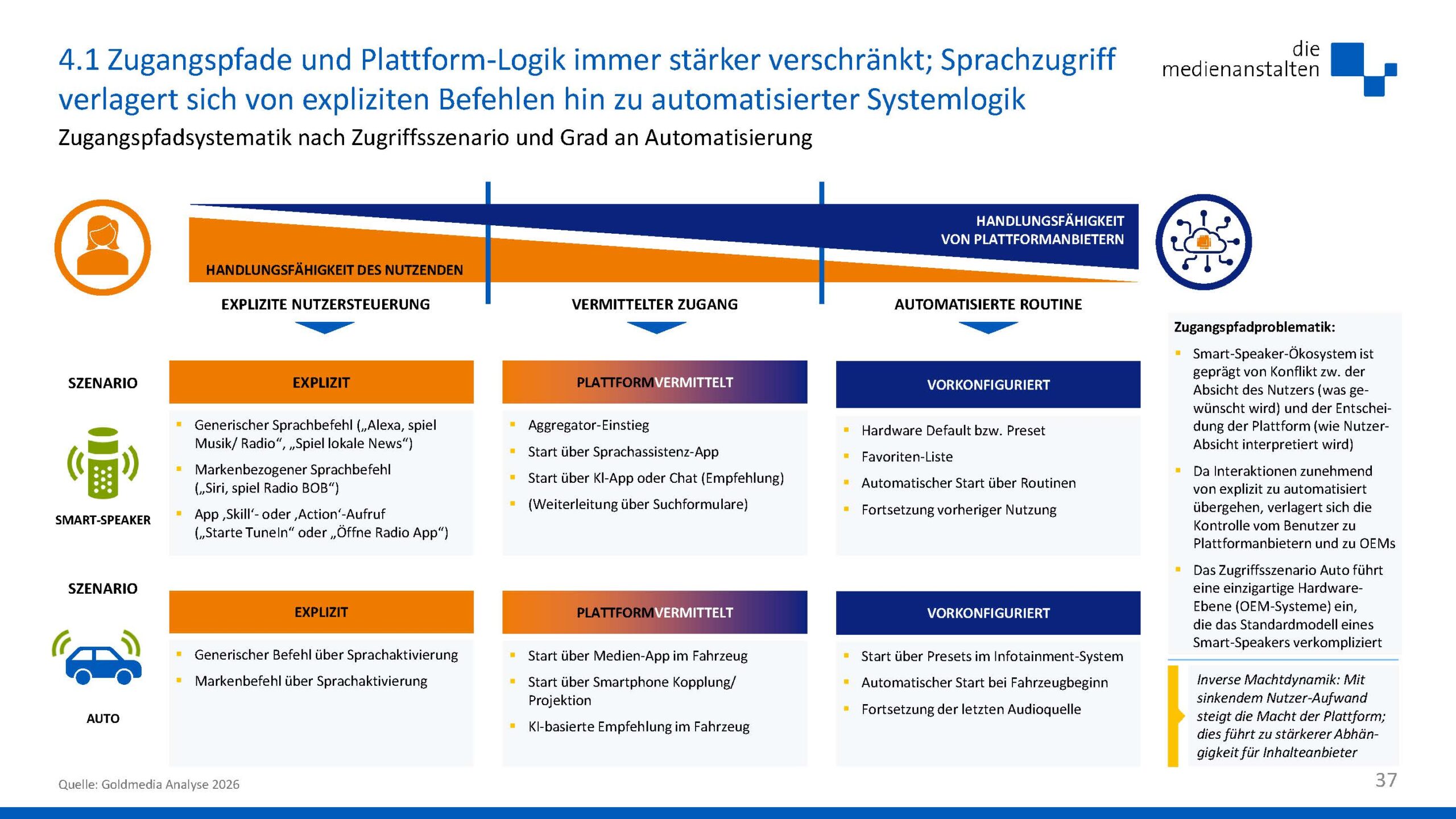
Zugangspfade zu Smart Speakern und Fahrzeugen zeigen den Wandel von direkter Sprachsteuerung zu plattformgesteuerten und automatisierten Zugriffswegen.
Control over access to audio content is increasingly shifting from users to platforms. Whilst direct voice commands are becoming less important, platforms, AI recommendations and automated routines are increasingly taking over the selection and prioritisation of radio, music and podcast content. Source: Goldmedia study „The Importance of Smart Speakers for German Radio“, commissioned by the media authorities (2026).

Goldmedia study, May 2026

Smart speakers are long since more than just an additional distribution channel for radio. Power in the audio market is increasingly shifting towards the platforms, because Amazon, Google and Apple control the value chain from the hardware to the AI routing.

For radio stations, this creates a central problem: they supply content, but have only limited influence on discoverability, data access and monetisation. In May 2026, Goldmedia GmbH produced the study „Importance of smart speakers for German radio: Perspectives - Opportunities - Risks“ on behalf of the directors' conference of the media authorities (DLM). It sheds light on the structural imbalance between radio stations and the dominant smart speaker platforms.

platform power

Platforms: In the smart speaker market, Amazon, Google and Apple control the value chain from hardware to AI routing.

Radio station Commercial radio broadcasters are becoming content suppliers without decisive influence on discoverability, data access, or monetisation.

The structural asymmetry in the smart speaker market

The study describes an asymmetric market structure in which platforms hold the decisive levers and radio broadcasters are structurally weaker positioned in the smart speaker environment.

Particularly relevant is the data gap: without sufficient access to data, targeted marketing is made more difficult, while platforms can use the same data to build their own audio offerings.

According to the study, the value-exchange model also shows that the equivalent value for radio falls well short of the value that platforms derive from its use. In a best-case scenario, existing findability regulations, fair data access and greater routing transparency could contribute to a more balanced distribution of value.

Otherwise, without appropriate measures, the radio sector could lose a cumulative total of 265 million euros in gross margin and 65 million euros in net value added between 2026 and 2030.

data gap

Missing data: Radio stations receive barely any context data, routing information, or sociodemographic profiles for addressable advertising.

Platform Black Box: Following a voice command, the voice assistant automatically decides which content or service to play. This makes it difficult to measure reach and advertising impact accurately.

Economic impact: Whilst platforms can use the data for their own audio services, radio stations’ marketing opportunities remain limited and the CPM is stagnating.

The changing market

The market has grown significantly in recent years. In 2025, around 50 million devices were being used for smart speaker services in Germany. Around 12 million households owned such devices.

At the same time, the study shows that a large proportion of smart speaker usage does not generate any real additional reach, but rather shifts existing radio listening to a different listening context.

Smart speakers therefore create new usage scenarios, but do not automatically result in financial gains for radio stations.

Goldmedia study, May 2026

Infobox – The development of voice assistants

Daily range: The number of people using smart speakers on a daily basis rose from around 0.7 million in 2019 to around 4.9 million in 2025.

Audio usage: During the same period, the number of people using audio content via smart speakers rose from 5.8 million to 16.2 million.

Why platforms are becoming a risk

The real challenge lies not just in the technology, but in the platform logic. Access via voice often means access via aggregators, pre-set services and routing mechanisms that lie outside the broadcasters' control.

Goldmedia study, May 2026

This means that it is no longer the broadcaster alone that decides on its visibility. The platform plays a decisive role in determining how users access the content.

Furthermore, the problem is exacerbated by the fact that platforms have multiple sources of revenue, whereas private radio stations monetise their content on smart speakers primarily through advertising.

AI is making the situation worse

The study sees generative AI as a catalyst for this trend. As a result, voice assistants are increasingly becoming personalised content systems that not only deliver content, but also select and prioritise it.

This increases the risk that smart speakers will become even more dominant gatekeepers and that radio will lose its significance in the voice channel.

This development is particularly concerning because the study views future platform power not as a marginal issue, but as a structural shift in the audio market.

What radio needs to learn from this

Radio remains particularly strong when it comes to providing information, whilst streaming and podcasts have their advantages in other usage scenarios.

For broadcasters, this means that not every usage scenario is equally at risk. In the smart speaker sector, however, competition for discoverability, usage time and revenue is intensifying.

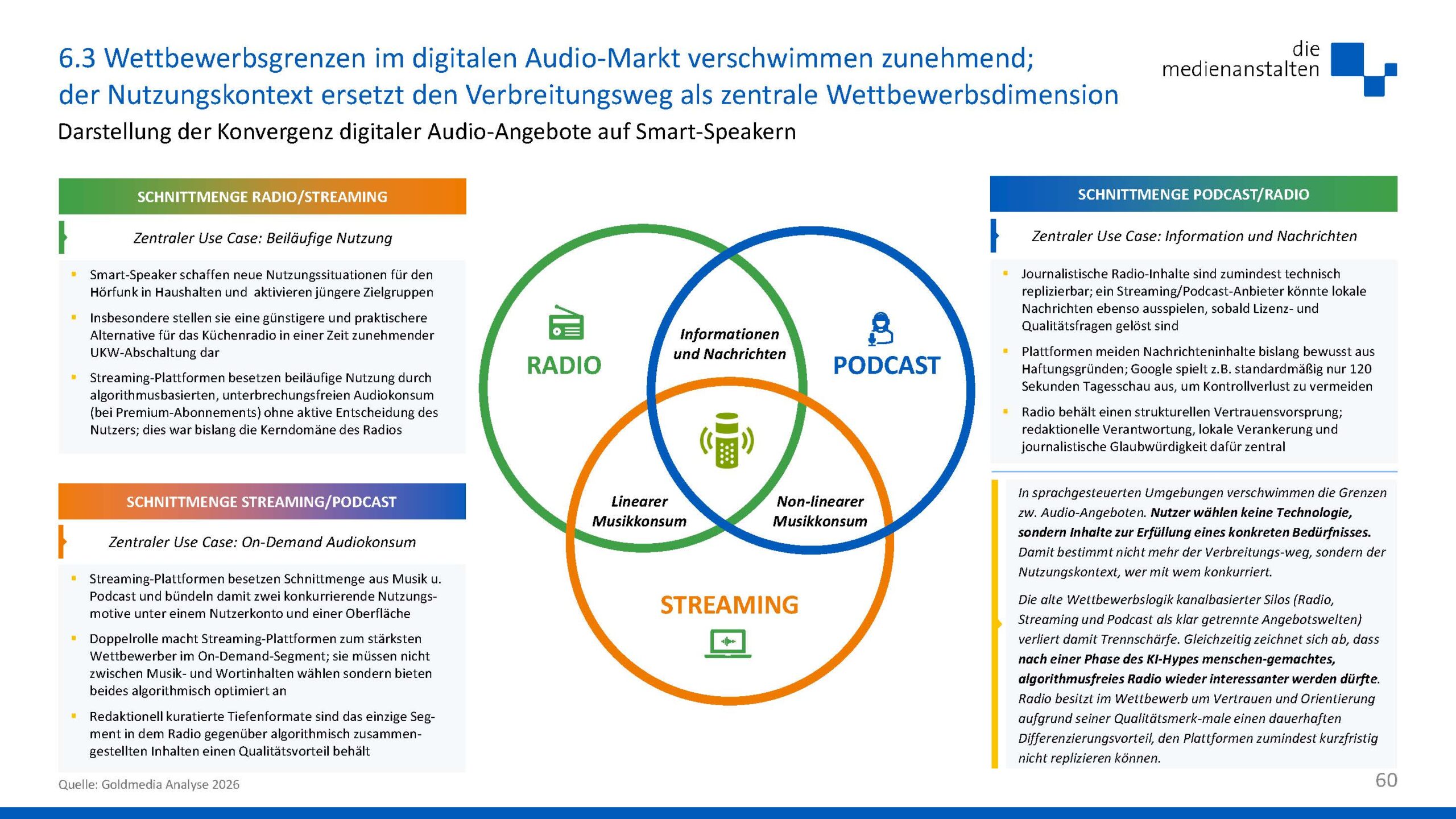
Venn-Diagramm zeigt die zunehmende Konvergenz von Radio, Streaming und Podcasts auf Smart Speakern sowie die Überschneidungen ihrer Nutzungsszenarien.
On smart speakers, the boundaries between radio, streaming and podcasts are becoming increasingly blurred. The choice of audio content is increasingly determined not by the distribution channel, but by the context of use and the platform through which the content is provided. Whilst the offerings are becoming more similar from a technical perspective, radio remains an important differentiating factor, particularly when it comes to trustworthy news and regional content. Source: Goldmedia study „The Importance of Smart Speakers for German Radio“, commissioned by the media authorities (2026).

Goldmedia study, May 2026

Smart speakers are long since more than just an additional distribution channel for radio. Power in the audio market is increasingly shifting towards the platforms, because Amazon, Google and Apple control the value chain from the hardware to the AI routing.

For radio stations, this creates a central problem: they supply content, but have only limited influence on discoverability, data access and monetisation. In May 2026, Goldmedia GmbH produced the study „Importance of smart speakers for German radio: Perspectives - Opportunities - Risks“ on behalf of the directors' conference of the media authorities (DLM). It sheds light on the structural imbalance between radio stations and the dominant smart speaker platforms.

platform power

Platforms: In the smart speaker market, Amazon, Google and Apple control the value chain from hardware to AI routing.

Radio station Commercial radio broadcasters are becoming content suppliers without decisive influence on discoverability, data access, or monetisation.

The structural asymmetry in the smart speaker market

The study describes an asymmetric market structure in which platforms hold the decisive levers and radio broadcasters are structurally weaker positioned in the smart speaker environment.

Particularly relevant is the data gap: without sufficient access to data, targeted marketing is made more difficult, while platforms can use the same data to build their own audio offerings.

According to the study, the value-exchange model also shows that the equivalent value for radio falls well short of the value that platforms derive from its use. In a best-case scenario, existing findability regulations, fair data access and greater routing transparency could contribute to a more balanced distribution of value.

Otherwise, without appropriate measures, the radio sector could lose a cumulative total of 265 million euros in gross margin and 65 million euros in net value added between 2026 and 2030.

data gap

Missing data: Radio stations receive barely any context data, routing information, or sociodemographic profiles for addressable advertising.

Platform Black Box: Following a voice command, the voice assistant automatically decides which content or service to play. This makes it difficult to measure reach and advertising impact accurately.

Economic impact: Whilst platforms can use the data for their own audio services, radio stations’ marketing opportunities remain limited and the CPM is stagnating.

The changing market

The market has grown significantly in recent years. In 2025, around 50 million devices were being used for smart speaker services in Germany. Around 12 million households owned such devices.

At the same time, the study shows that a large proportion of smart speaker usage does not generate any real additional reach, but rather shifts existing radio listening to a different listening context.

Smart speakers therefore create new usage scenarios, but do not automatically result in financial gains for radio stations.

Goldmedia study, May 2026

Infobox – The development of voice assistants

Daily range: The number of people using smart speakers on a daily basis rose from around 0.7 million in 2019 to around 4.9 million in 2025.

Audio usage: During the same period, the number of people using audio content via smart speakers rose from 5.8 million to 16.2 million.

Why platforms are becoming a risk

The real challenge lies not just in the technology, but in the platform logic. Access via voice often means access via aggregators, pre-set services and routing mechanisms that lie outside the broadcasters' control.

Goldmedia study, May 2026

This means that it is no longer the broadcaster alone that decides on its visibility. The platform plays a decisive role in determining how users access the content.

Furthermore, the problem is exacerbated by the fact that platforms have multiple sources of revenue, whereas private radio stations monetise their content on smart speakers primarily through advertising.

AI is making the situation worse

The study sees generative AI as a catalyst for this trend. As a result, voice assistants are increasingly becoming personalised content systems that not only deliver content, but also select and prioritise it.

This increases the risk that smart speakers will become even more dominant gatekeepers and that radio will lose its significance in the voice channel.

This development is particularly concerning because the study views future platform power not as a marginal issue, but as a structural shift in the audio market.

What radio needs to learn from this

Radio remains particularly strong when it comes to providing information, whilst streaming and podcasts have their advantages in other usage scenarios.

For broadcasters, this means that not every usage scenario is equally at risk. In the smart speaker sector, however, competition for discoverability, usage time and revenue is intensifying.

Goldmedia study, May 2026

Anyone who wants to remain relevant there must not only provide content, but also actively consider the factors that determine visibility, measurability and marketing.

Greater fairness in the market

The study identifies clear areas for action in this regard: greater regulation of discoverability, improved access to data, more transparent routing logic and greater bargaining power for providers.

According to the study, these include, amongst other things, ‘must-carry’ approaches for the voice channel, disclosure requirements regarding routing, and standardised minimum data.

At the same time, the question arises as to how broadcasters can tackle these areas of action in practical terms. As long as platform power remains structurally entrenched, private radio stations in particular will find it difficult to counter the growing influence of companies such as Amazon, Google and Apple, as well as their voice assistants.

Politicians are all the more required to create framework conditions that enable fair competition for both sides.

Conclusion

Smart speakers are both an opportunity and a risk for radio. They expand the ways it can be used, whilst simultaneously shifting power, data and monetisation in favour of the platforms.

With AI, this trend is likely to intensify rather than weaken.

For radio stations, therefore, it is crucial not only to be present on platforms, but also to remain discoverable, measurable and economically viable there.

Yours sincerely, Yasmin Konken


These posts might interest you.

Stammkunden sind das Gold des Vertriebs